


The water will slow down the overall drying process so there are fewer and smaller cracks.
I have a big bag of carving wood chips.
All my waste acrylic paints go in there. Once polymerized, they are not an environmental hazard
to aquatic wildlife.
The water will slow down the overall drying process so there are fewer and smaller cracks.
I have a big bag of carving wood chips.
All my waste acrylic paints go in there. Once polymerized, they are not an environmental hazard
to aquatic wildlife.
The cat relief carving in #4. That is exactly how they sit.
Not my picture, could have been in my village.
Those cats are always around here.
I like the wolf and the lynx the most.
He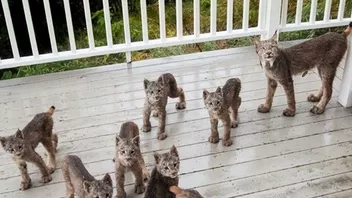
Welcome from the very far west. I hope you show us some carvings soon.
We have Sandhill Cranes here form time to time. Nice to watch. Yours have the right proportions.
I have been carving conifer wood for some 20 years. Western Red Cedar, Yellow Cedar and a little spruce and pine.
Always do a count of annual rings to find the best carving wood. I use wood with 15 - 30 rings per 25 mm.
Less than 12 is much too soft, it crushes. More than 40 is like bone but you can cut it if you need to.
Not me. I carve what I see in the wood. Professionals sell what they carve, I do not.
You can see some of my tools and carvings in The Showcase.
I like to use the carving tools from the First Nations designs.
This just takes a lot of practice and a long time in the shop!
I like it because I can look out my windows and see my grapes ripening. We will harvest in 21 days.
Welcome Marcel. I grow grapes in the Canadian Rocky Mountains. Wood carving in the winters.
There is good help in these forums. I use Google Translate. Good most of the time.
Yes. To the eye, it looks like polishing. It is really a very fine abrasive but the scratches are microscopic.
I find it essential to carve soft western red cedar and yellow cedar.
I have repaired carving gouges like those ones. I have a 6-speed grinder.
Carefully grind off the poor edge and start over, completely.
Little by little, so it does not over heat the metal.
I make all the gouges 20 degrees and all the knives 12-15 degrees.
I will take them all through 600, 800, 1,000, 1,200 and 1,500 grits before honing with Chromium Oxide green.
Good Luck. It is much work to repair an edge that has hit a sand grain.
Yu must shave off the entire surface with an edge that you do not care too much about.
Either that, or start over. That's what I would do.
Use steam-heat to straighten wood. I never sand my carvings. Use cabinet scrapers if you can.
It does not look like any woods of genus Tilia ( Lime, basswood) to me. The growth rings are too big and too obvious.
Branch wood has very difficult grain when compared with wood from the main stem.
In eastern North America, the basswood from the south is very poor and the basswood from the north is much better to carve.
Hello from half a world away in the Canadian Rockies. I use Google Translate, not so good sometimes.
Our sawmills are the cheapest and I can pick over the wood.
Sometimes, I buy fence posts, glue pieces together.
Welcome.
I suggest the kinds of rough tools that the First Nations of the Pacific Northwest use.
Both the elbow adze and the D-adze. The elbow adze has been called a "band-saw on a stick."
There are blade smiths across Europe that make adze blades.
First, is the handle the right size for your hands?
Palm up, fist grip, the tips of your second and third fingers should just touch the base of your thumb.
The best size for my hands is 21 mm diameter.
Second, I wrap many handles with tarred nylon seine fish net cord. It is a little sticky.
Many bird carvings are very stiff, almost dead. You carved very active birds.
Your paint is excellent, too. Hope you can translate this!
Welcome Uwe. Many good carvers here to learn from.
You can see my tools and some carvings in the Showcase forum.
I use Google Translate (free) to change this whole site into English.
My German was 50 years ago and I never used it.
I hope you enjoy wood carving. Extremely sharp tools are most important.
Welcome. In my avatar, you can see two curved carving knives in a dish of yellow cedar.
Those knives are worn down and useless farrier's horse hoof trimming knives. Sometimes for free.
Very good steel for wood carving. Grind the blade tips to suit yourself.
I have 24+ of them and other wood working chisels.
Sorry, I do not know how to apply Google Translate to German.