


The Google Translator does a very good job in this wood carving site.
I studied German language in 1965. I have forgotten everything.
The Google Translator does a very good job in this wood carving site.
I studied German language in 1965. I have forgotten everything.
The quartz makes very good water.
I like the position of the clock in the canopy of the trees.
Greetings Nicolas, from the western side of the Rockies in Canada @ 53N.
The relief depth could be much more to show a third dimension.
You will need to do more to make the bevel tool edges "carving sharp."
For a first work, it is very good.
How tall is it? About 30 cm? The wood is linden/Tilia?
Welcome from the Pacific Northwest region of Canada.
Danke. Is how you say it? Thank you. I make my own carving benches for the wood shapes that I use.
A big wood working bench is a table like many others. Mine for small story poles are very different.
My grandmother predicted that I would carve what I see in the wood. It happens. I never know what it will be.
The butterfly story poles had no names until one day, I saw what to carve.
Very nice wood costs very little here so I can buy a lot of it just to pile up in case I see something.
I will show you a big turtle soon. I looked at the wood for 2+ years before I saw the turtle within it.
Excellent. I like the handle design.
Poles you always read from the bottom to the top.
The figure at the bottom must have the strength to hold up everybody else.
The butterfly poles will begin at the bottom with eggs then lots of very small caterpillars.
Then the caterpillars grow but there are fewer of them.
Near the top will be the silk cocoon on the back side. Then the butterfly top, front.
The frog pole is quite short, less than 60 cm I recall.
This carving bench has a shelf below which moves up and down so I can work on the tops of carvings.
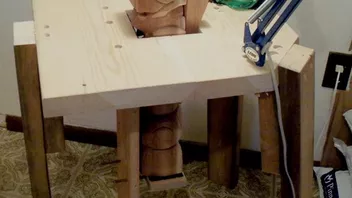
I found a missing picture folder!
Here in the Pacific Northwest, there are three different kinds of poles
1. Totem poles. They tell your family heritage. Read from the bottom up, that pole stands
in front of your house and faces the water for all to see.
2. Mortuary poles. That is like a grave stone and tells who you were in life.
3. Story poles. Anybody can carve these. They tell of an adventure or history.
Mine show the life if different animals. Not finishes. One show the life of a frog from egg to adult.
Another pair show the life of a butterfly, from eggs to caterpillars to cocoon to adult.
The butterfly poles are 13 cm x 13 cm x 160 cm western red cedar.
As you can see, carving the caterpillars is very tedious. Will do all the eggs at the bottom, next.
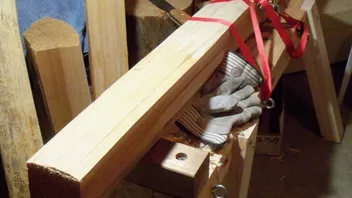
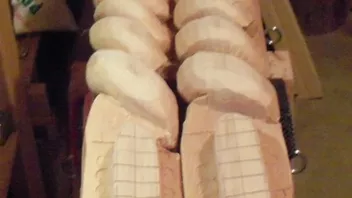
Excellent. All those shapes are very hard to make the same.
Hello Berkow,
Thank you, I have been very sick and recovering interest in carving again.
I buy the steel blades for the elbow adze, the D-adze and all the crooked knives.
I make all the handles and fix the blades.
There are several very good blade smiths in the Pacific Northwest, both in USA and in Canada/BC.
These are 2 examples:
I wanted to learn about the kinds of wood carving tools used by the First Nations here.
The best start is to make some carving tools. Make the handles the right size to fit my hands.
Then do carvings with the influence of the art and carvings which we see every day here.
Here are a few carvings.
Good day: I stopped using gouges maybe 5-7 years ago. I now carve with the tools common to the Pacific Northwest First Nations.
These be crooked knives and adzes. Mostly western red cedar, some yellow cedar and birch. Copper and abalone shell inlay.
I.will add more in time.
You want a dull ax for splitting. The wood splits in front of the edge. A sharp ax cuts and sticks in the wrong direction.
I only work with split wood for all my carvings. I have dull axes, wedges and a froe for this.
A sculptor's ax or adze wants to be no better than what you have already. Save your money.
Spoon carving wastes a lot of wood, never less for anybody.
Carving bowls and dishes uses even more wood. My dishes are no more than 15% of the wood block blank.
Thank you. I see several very different carving styles.
How many artists were involved in this project?
The weathering is very traditional here for native carvings.
Totem poles, story poles and mortuary do not last much more than 100 years.
They are meant to be a life which ends.
What am I looking at? Some mix of hand work and some power (chainsaw) carving?
I don't do Flat Plane carving and don't know which knives are the best for it.
Americans use some folding pocket knives. Maybe chip-carving knives would work.
I can't use stones any more. They are all the wrong shapes for the curved edges of the adzes and the crooked knives.
You can see what these look like at:
So I use 3M sandpapers. 1,500 grit is fine enough BUT, the honing step with CrOx/AlOx is most important.
With hand work, I can feel the edge dull in 30-40 minutes and honing repairs that very quickly.
Flat-plane carving is not whittling to me. It is a very deliberate effort to approximate the features of faces and bodies with
flat segments, joined together. The result is usually very distinctive, not just a random collection of cuts and grooves.
I think it takes great confidence to shape a face of flat pieces. I don't do flat-plane, I don't even have useful knives for that.
I buy some examples to add to my collection.
I use a very bright light to examine the edges for damage.
I use 3M fine automotive wet & dry finishing sandpapers on a hard flat surface.
I begin with 800 grit, then 1,000, then 1500 grit paper. Maybe 600 start if there is serious damage to the edge.
I use Chromium Oxide and Aluminum Oxide honing compound on hard, thick paper for finishing.
CrOx is 0.5 micrometer, AlOx is 0.25 micrometer nominal particle sizes. That's good for western red cedar.